
by Bruce Kaser
Grass seed farmers in the Waldo Hills, heading up toward Silver Creek Falls State Park, have been visibly struggling the last couple of years. With seed contracts drying up, many fields have gone unplanted. When 5 acres of former foundation seed ground came available, I decided to use the industry downcycle to run an experiment.
For the past six years, we’ve been managing Crimson clover in an 18 acre Jefferson orchard (now certified organic). The whole thing began with a simple hand toss of seed at the head of two rows when we committed to transitioning the orchard to organic. We let the clover reseed naturally in the tree line each year, and it slowly spread farther down those rows.
A warning: this approach is not for the faint of heart. It only works if you’re willing to flail early and often. We eventually figured out a harvest protocol that works, though machinery runs slower than in conventional orchards.
This orchard had been struggling for several reasons—Jefferson’s lower heat tolerance and the fact that it was planted on dryland hill ground. But two Septembers ago, I noticed something different. The trees in the clover rows were greener than the rest at the end of the summer dry period. The spot where I tossed that first handful of seed seemed to be thriving. Those trees simply weren’t showing the heat stress the rest of the orchard displayed.
Since then, both instate and out of state soil scientists have looked at what’s happening in those rows. They’ve documented higher organic matter percentages, lower soil temperatures, and better moisture retention moving from spring into summer. And then came a surprise: last winter Shannon Cappellazzi, a soil health specialist at OSU, told me her samples showed tuber-forming fungi associated with edible truffles. It was too late in the season to look for truffles themselves, but a truffle- hunting dog we used later found Rhizopogon fungi.
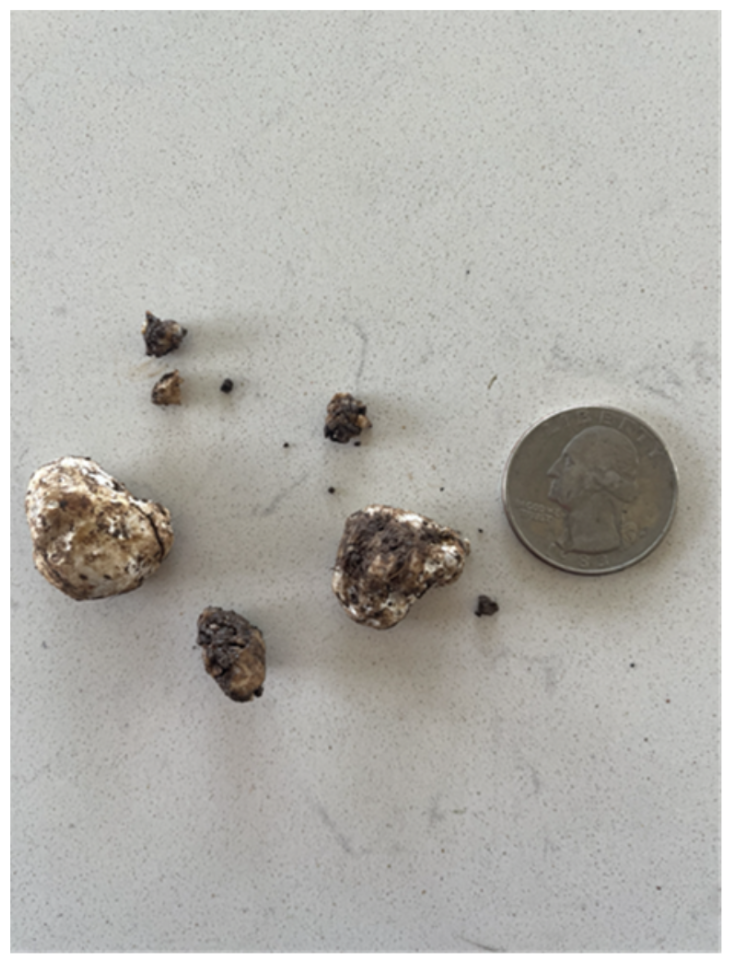
Rhizopogon fungi found in the Pratum Farm orchards
Which brings me back to the 5 acres. The Jefferson/Crimson experiment showed enough promise that last year I planted three clover varieties there: Crimson, Persian, and Balansa. There have been no added treatments of any kind. Not all clovers behave the same. Some fix more nitrogen, some produce more biomass, and each has a different carbon to nitrogen (C:N) ratio that determines how quickly plant material disappears after flailing. Crimson will be the showiest in bloom, Persian the most fragrant, but so far Balansa is the clear winner for biomass and nitrogen fixation potential.
After a mild winter, the Balansa was already over a foot tall by April 10. If it were in the orchard, I’d be flailing it now. No one seems to really know, but according to USDA and other fact sheets, flailing at this stage might fix as much as 80–120 pounds of nitrogen per acre—compared to the roughly 200 pounds of synthetic nitrogen we used to apply. And as many growers know, “200 pounds applied” is not the same as “200 pounds taken up,” because synthetics ablate and leach quickly.
One more benefit: this year’s weed suppression in the Balansa has been phenomenal relative to the others. And the ground squirrels don’t seem to like living in it either—80 in the orchard last year.
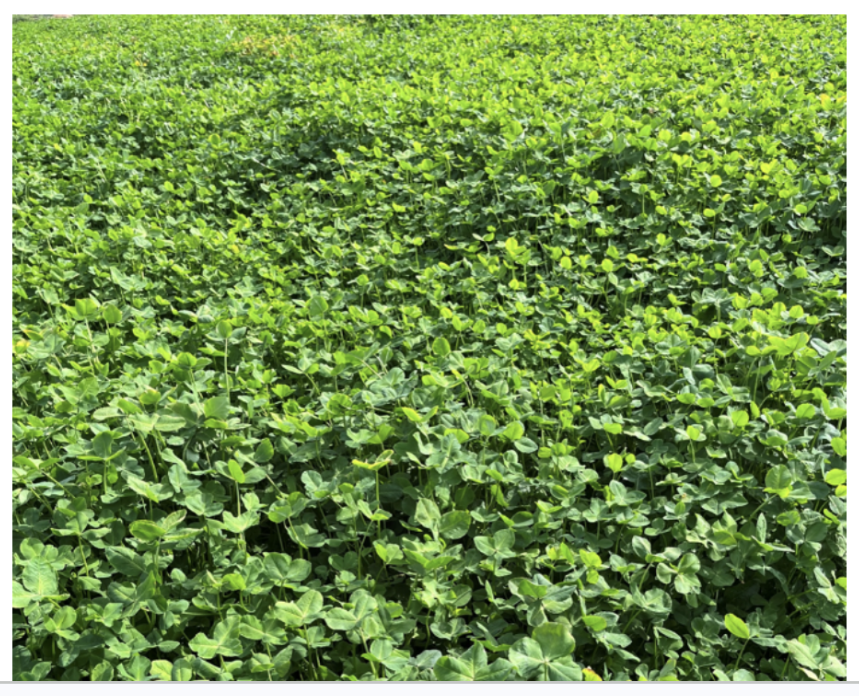
A beautiful cover cover growing between the rows of hazelnut trees
